Postflop Basics — Decision Framework
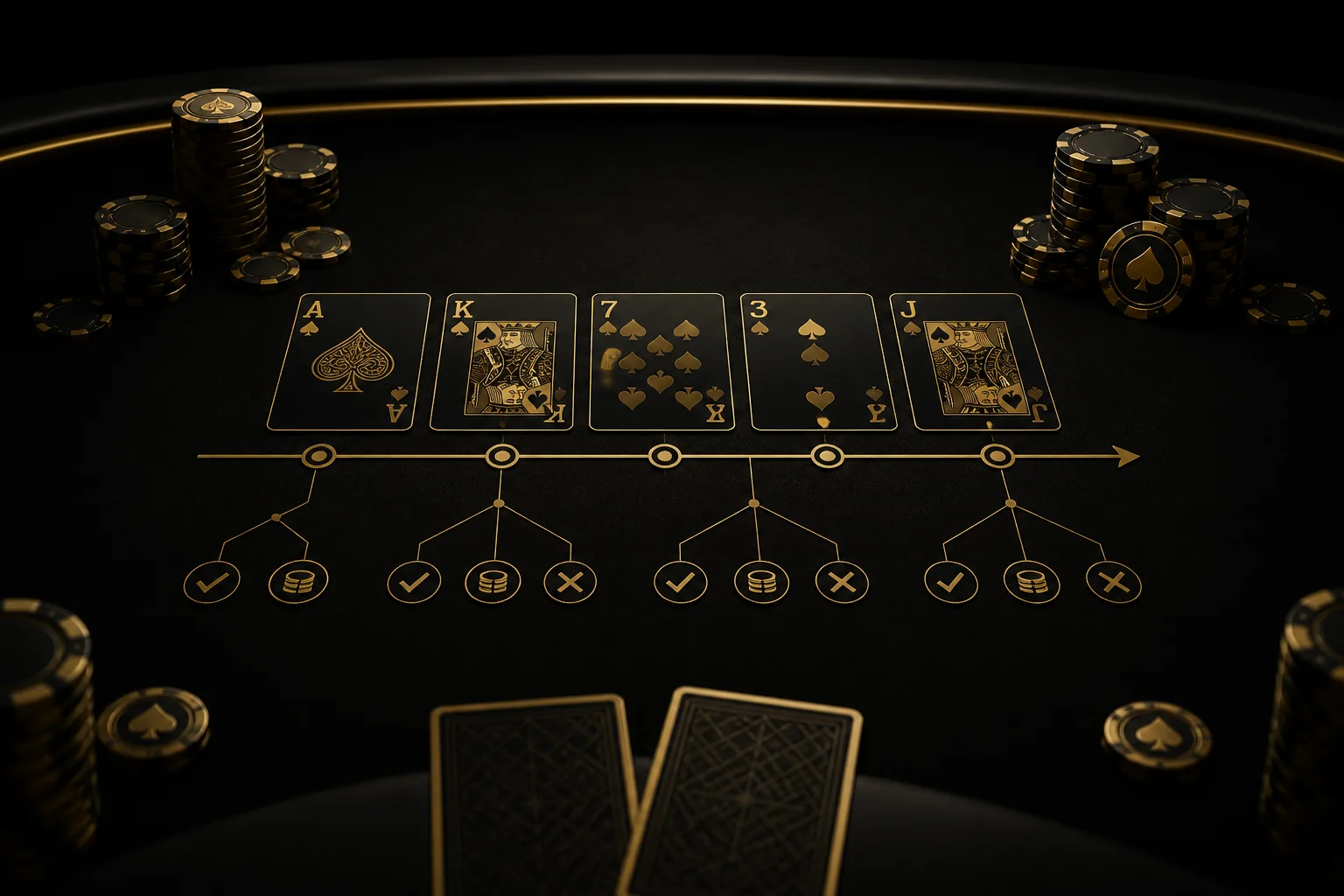
Postflop covers every decision on the flop, turn, and river. After preflop, most of your profit (or loss) is decided here. This framework is the foundation for Hold'em at Baatryn Öröö.
If preflop strategy is the door, postflop is the room. Weak preflop hands make postflop miserable. Strong ranges make decisions simpler.
What you know after preflop
- Your hand strength (pair, overcards, draw, air)
- Position (in position or out of position)
- Who was the aggressor (last raiser preflop)
- Pot size and effective stack depth
Also review: table position in poker.
Hand types postflop
| Type | Example | Default action |
|---|---|---|
| Made hand | Top pair, two pair | Value bet |
| Draw | Flush draw, straight draw | Semi-bluff or call (pot odds) |
| Air | High card, missed draw | Check/fold, sometimes bluff |
| Monster | Set, straight, flush | Value, larger bet sizing |
Flop framework
In position (IP) — you act last:
- C-bet on boards that favor your range (if you were the aggressor)
- Check back weak hands and some medium pairs
- Float bets to steal on later streets: floating strategy
Out of position (OOP) — you act first:
- Check-call medium strength hands
- Check-raise strong hands and combo draws
- Check-fold weak hands without equity
Turn decisions
Ask on every turn card:
- Did the board change? (flush completes, board pairs)
- Did my equity improve or collapse?
- What is stack-to-pot ratio (SPR)?
SPR < 4: All-in decisions come up often. SPR > 10: More streets to maneuver.
Example: 3000₮ pot, 9000₮ effective stack → SPR = 3. One big bet and you are committed.
River decisions
Simplest rule: value or bluff — pick one.
- Value: weaker hands may call → bet
- Bluff: fold equity exists and you block nuts → bet
- Check: showdown is enough, or you are bluff-catching
Art of bluffing — triple-barrel bluffs need the right opponent and board.
Multiway pots
3+ players — play tighter:
- C-bet less (someone usually connected)
- Bluff less (harder to fold everyone)
- Value bet larger when you have the nuts
- Position matters even more
Practical checklist
On the flop ask:
- Do I likely have the best hand?
- Do I have a draw? What are pot odds?
- Is position in my favor?
- How many opponents remain?
Enough yes answers → bet or call. Otherwise → check or fold.
Common mistakes
- Triple-barrel bluffing with pure air
- Always checking top pair (missing value)
- Calling draws without pot odds
- Too many c-bets out of position vs multiple players
- Ignoring board texture changes on turn
Study plan
- Master c-bet + check-fold weak hands
- Add check-raise with strong hands
- Learn turn and river value sizing
- Track stats: C-bet %, fold to c-bet (poker statistics)
FAQ
What to learn postflop first?
C-bet on good boards, check-fold air. Build from there.
Do I need statistics?
Yes. C-bet % and fold to c-bet help you exploit opponents.
How does mindset fit?
Tilt ruins postflop. Read poker psychology and mindset.
Omaha postflop?
Same framework, but more draws and bigger pots. See Omaha rules.
Example walkthrough
You raise K♠Q♠ on the button. BB calls. Flop Q♥ 7♦ 2♣. BB checks. Bet 50% pot — top pair value. BB calls.
Turn 9♠. BB checks. Bet 66%. River 3♥. Value bet 50% or check vs passive opponent.
If flop were Q♥ J♥ 10♥, check back — too many straights and flushes.
Play one table while learning. Use the flop checklist for 100 hands.
When unsure postflop, default to check-fold out of position. Aggression costs more OOP because you act first on every street without information.